Sunday, June 30, 2019

Seylan Bank of Sri Lanka

Seylan Bank (PLC) is a licensed commercial bank and a public limited liability company incorporated in Sri Lanka and listed on the Colombo Stock Exchange. The Bank commenced operations in 1987 and is currently recognised as a premier bank in Sri Lanka.

Products of the Seylan Bank

Personal

Savings Accounts

  • Seylan Sure


·         Offers definite benefits for personal savings and current account holders
·         Individuals aged above  18 years

  • Tikiri


·         Big account for little ones
·         Children below 15 years of age

  • Seylan Harasara


·         Senior citizens account
·         Senior citizens aged above 55 years

  • Money Market Savings Account


·         Short-term savings account  with higher interest rate
·         Corporate, individual clients and collection accounts of institutions
  • Seylfie

·         Youth account with rupee and digital interest option
·         Youth aged between  18-26 year
  • Income Saver Account


·         Savings account for monthly regular income earners
·         Individuals who earn a regular monthly income


Fixed Deposits

  • Millennium 30


·         30-day fixed deposit to Corporate, SME, retail and individual clients
·         Flexi Deposit Allows depositor to select the time period of the fixed deposit

  • Seylan Shakthi


·         4-year fixed deposit Interest and reward benefits

  • 5star


·        5-year fixed deposit

  • NRFC


  • Thilina Sayura


·         Foreign currency deposit  account with rewards
·         Non-resident and Sri Lankan individuals who earn foreign exchange

Lending Products

Loans

  • Seylan Home Loans


·         Home Loans up to LKR 100 Mn. for construction or purchase of  a house or apartment
·         Fixed interest rates
·         Offer for primarily salaried individuals, professionals and businessmen

  • Seylan Loan  Against Property


·      Loans made available against your residential property to upgrade your lifestyle, grow your business or for investments
·         Fixed interest rates and doorstep service
·         Offer for salaried individuals with residential property under their name

  • Seylan Personal Loans


·         Personal loan for any related purpose
·         Fixed Interest rates, doorstep service and approval within two days
·         Offer for salaried individuals employed at reputed companies, professionals, government servants and armed forces

  • Seylan SME


·         Specialised loan scheme for  SME sector

  • Scholar Loans


·         Unique higher education loan scheme

  • Seylan Gold Loans


·         Instant short-term loan facility against gold articles
·         Offer for corporate and individual clients

Pawning


  • Seylan Pawning


·         Cash advance against gold

Leasing

  • Seylan Leasing


·      Finance leases for vehicles, motorcycles, machinery, plant and equipment

Other Services

  • Seylan Credit and Debit Cards


·        Visa
·        Master credit and  debit cards
·        Including rewards, merchant discounts
·        Offer for individual clients

  • Overdrafts


·         Overdraft facilities for personal and corporate current account holders

  • Trade Finance


·         Imports and Exports Commission and interest benefits
·         Offer for corporate, SME, retail and individual clients

  • Seylan Factoring


·        Provides working capital requirements against trade receivables
·        Offer for corporate, SME, retail and individual clients

  • Seylan eBanking


·         Able to carry out a variety of banking functions at their convenience by the click of  a button
·         Low charges
·         24 x 7 accessibility
·         Offer for Corporate, SME, retail and individual clients, minor and credit cardholders

  • SEY Cash


·         Bank’s remittances platform

  • SMS Banking


·         Opportunity to carry out selected banking functions via SMS
·         Free up to a number of SMSs and convenience
·         Offer for Corporate, SME, retail and individual clients, minor and credit cardholders

  • Seylan Suhada Sewa

·         Dedicated service for those people in the society in need of attentiveness
·         Free of charge and convenience
·         Offer for Clergy, senior citizens, differently-able people, pregnant ladies and mothers with infants

  • Treasury investments


  • Margin trading facilities


  • Offshore banking


CENTRAL BANK OF SRI LANKA 


History
To accommodate dynamic economic and financial system developments upon gaining independence in 1948, the post-independence Government of Ceylon (as Sri Lanka was then known) established the Central Bank of Ceylon to maintain an active monetary policy regime and a dynamic financial sector to support and promote economic growth.
Prior to the establishment of the Central Bank, the Currency Board System set up under the Paper Currency Ordinance No.32 of 1884 functioned as the country’s Monetary Authority, though very narrow in its capacity. This system was deemed inadequate for a developing country upon gaining political independence. 

Objectives of the Central Bank
  (a)  The stabilisation of domestic monetary values (maintenance of price stability).
  (b)  The preservation of the par value or the stability of the exchange rate of the Sri Lankan Rupee (maintenance of exchange rate stability).
  (c)  The promotion and maintenance of a high level of production, employment and real income in Sri Lanka.
  (d)  The encouragement and promotion of the full development of the productive resources of Sri Lanka
Introduction
The Central Bank of Sri Lanka (CBSL) is the apex institution in the financial sector in Sri Lanka. It was established in 1950 under the Monetary Law Act No. 58 of 1949 (MLA) as a semi-autonomous body and is governed by a five-member Monetary Board.
The CBSL seeks to achieve and maintain two core objectives to maintain a healthy and stable economic and financial system while maximising resource utilisation effectively. These objectives are:
      1.    The maintaining of economic and price stability
      2.    The maintaining of financial system stability
The MLA has also granted the CBSL sole authority to issue currency notes and coins to the public. Therefore, the Bank is responsible for currency issuance and management.

Function
Core Functions
The core functions of the CBSL are:
(a) Conduct of monetary policy.
(b) Conduct of exchange rate policy.
(c) Management of the official international reserves.
(d) Oversight of the financial system.
(e) Licensing, regulation and supervision of banks and selecting non – bank financial institutions.
(f) Provision of settlement facilities and the regulation of the payment system.
Agency Functions
In addition, the CBSL also performs the following agency functions on behalf of the Government of Sri Lanka:
(a) Management of the public debt.
(b) Foreign exchange management.
(c) Fund management and acting as the custodian of the Employees’ Provident Fund.
(d) Facilitating financial inclusion.
(e) Financial intelligence services to detect and prevent money laundering and terrorist financing.
Laws and Regulations
·       Monetary Law Act (MLA) No. 58 of 1949

Monetary Law Act No. 58 of 1949 establish the monetary system of Sri Lanka and the Central Bank to administer and regulate the system and to confer and impose upon the Monetary Board of the Central Bank powers, functions and responsibilities necessary for the purpose of such administration and regulation, and to provide for connected matters.


·       Payment and Settlement Systems Act No 28 of 2005

Payment and Settlement Systems Act No 28 of 2005 provide for the regulation of payment, clearing and settlement systems; for the disposition of securities on the books of the Central Bank; for the regulation of providers of money services.

Thursday, May 30, 2019

Financial Inter-mediation.

Introduction


 financial intermediary is an institution or individual that serves as a middleman among diverse parties in order to facilitate financial transactions. Common types include commercial banks, investment banks, stockbrokers, pooled investment funds, and stock exchanges. Financial intermediaries reallocate otherwise uninvited capital to productive enterprises through a variety of debt, equity, or hybrid stake-holding structures.
Through the process of financial inter-mediation, certain assets or liabilities are transformed into different assets or liabilities.[2] As such, financial intermediaries channel funds from people who have surplus capital (savers) to those who require liquid funds to carry out a desired activity (investors).
A financial intermediary is typically an institution that facilitates the channelling of funds between lenders and borrowers indirectly.That is, savers (lenders) give funds to an intermediary institution (such as a bank), and that institution gives those funds to spenders (borrowers). This may be in the form of loansor mortgages.Alternatively, they may lend the money directly via the financial markets, and eliminate the financial intermediary, which is known as financial disinter-mediation.

Mutual Funds as Financial Intermediaries.


Mutual funds provide active management of capital pooled by shareholders. The fund manager connects with shareholders through purchasing stock in companies he anticipates may outperform the market. By doing so, the manager provides shareholders with assets, companies with capital and the market with liquidity.


Advantages of Financial Intermediaries.


Through a financial intermediary, savers can pool their funds, enabling them to make large investments, which in turn benefits the entity in which they are investing. At the same time, financial intermediaries pool risk by spreading funds across a diverse range of investments and loans. Loans benefit households and countries by enabling them to spend more money than they have at the current time. 
Financial intermediaries also provide the benefit of reducing costs on several fronts. For instance, they have access to economies of scale to expertly evaluate the credit profile of potential borrowers and keep records and profiles cost-effectively. Last, they reduce the costs of the many financial transactions an individual investor would otherwise have to make if the financial intermediary did not exist. 

Disadvantages of Financial Intermediaries

.
There is no doubt that financial inter-mediation provides a number of advantages.However,it does not come without cost as both borrowers and lenders must pay for the benefits they receive.This generally means.
  • Increased cost of funds borrowing.
  • Reduced return for lending for savers.
  • Its less likely for secondary Financial assets to be securitised.

Friday, March 22, 2019

The basic knowledge of Banking industry


Introduction

When Sri Lanka or then known as Ceylon was under the reign of the Sinhalese Kings and even the Portuguese (1505-1656) and Dutch (1656-1796), banks and banking were still alien to the Sri Lankan culture. It was only during the British colony (1802-1948) that Banking was introduced to Sri Lanka with mainly branches of foreign banks being set up. 

The CBSL was established in 1950 under the MLA No.58 of 1949 which was a major milestone in Sri Lanka’s economic history. Today, the Central Bank is the governing body of commercial banks.

Commercial Banks have extended their services from traditional banking to other areas. Examples include, merchant and investment banking, financial and marketing consultancy services, leasing, insurance, hire-purchase, factoring, bill discounting, pawn broking, underwriting etc, etc. They have also changed from manual systems to computer based systems and now to internet based systems and with especially the new entrants to the field playing a major role in introducing or making use of state-of-art technology to deliver their products.


Financial Institution in Sri Lanka

Institutions Regulated by the Central Bank of Sri Lanka

  1.  Licensed Commercial Banks
  2.  Licensed Specialized Banks 
  3.  Registered finance companies
  4.  Registered Finance Leasing Establishments 
  5.  Authorized Primary Dealers

A law to regulate and supervise Micro-Finance Institutions is also being formulated. Action is being taken to establish an independent authority for monitoring micro- finance institutions. 

Licensed Commercial Banks 

(As at 01st March 2016)


No
Name & Address
Contact Nos.
1.
Amana Bank PLC 
403, Galle Road, 
Colombo 3
Tel. 
Fax 
E-mail 
Website
(94) 11 7756000
 (94) 11 2574419
 feedback@amana.lk
2.
Axis Bank Ltd 
356, Galle Road 
Colombo 3
Tel. 
Fax 
E-mail 
Website
(94) 11 2577733
(94) 11 2577724
manojkumaragrawal@
3.
Bank of Ceylon
BOC Square
No 1, Bank of Ceylon Mawatha 
Colombo 1
Tel. 
Fax 
E-mail 
Website
(94) 11 2446790 – 811
 (94) 11 2331160
 boc@boc.lk
4.
Cargills Bank Ltd 
696, Galle Road Colombo 03
Tel. 
Fax 
E-mail 
Website
(94) 11 7640000
(94) 11 7640502
infor@cargillsbank.com

5.
Citibank, N.A. 
65C, Dharmapala Mawatha
Colombo 7
Tel. 
Fax 
E-mail 
Website
(94) 11 2447316 - 8 
(94) 11 2445487
 ravin.basnayake@citi.com
6.
Commercial Bank of Ceylon PLC
"Commercial House"
21, Sir Razik Fareed Mawatha, 
P.O. Box 856 
Colombo 1

Tel. 
Fax 
E-mail 
Website
(94) 11 2430420
(94) 11 2449889
 info@combank.net
 www.combank.net 
7.
Deutsche Bank AG 
86, Galle Road 
Colombo 3
Tel. 
Fax 
E-mail 
Website
(94) 11 2447062 
(94) 11 2447067/2449589
 rohan.rodrigo@db.com 
8.
DFCC Bank PLC
73/5, Galle Road,
Colombo 3
Tel.  
Fax 
E-mail 
Website
(94) 11 2442442 
(94) 11 2440376
 info@dfccbank.com
9.
Habib Bank Ltd 
70A, Dharmapala Mawatha 
Colombo 03
Tel. 
Fax 
E-mail 
Website
(94) 11 2370391-2
(94) 11 2370389
 arif@hbl.lk
10.
Hatton National Bank PLC 
HNB Tower,Level 21
479, T B Jayah Mawatha,
Colombo 10
Tel. 
Fax 
E-mail 
Website
(94) 11 2664664
 (94) 11 2662772
 moreinfo@hnb.net
11.
ICICI Bank Ltd 
58, Dharmapala Mawatha 
Colombo 7
Tel. 
Fax 
E-mail 
Website
(94) 11 4242400 
(94) 11 4242442/4719611
biju.jacob@icicibank.com
12.
Indian Bank 
57, Sir Baron Jayatilleke Mawatha 
Colombo 1
Tel. 
Fax 
E-mail 
Website
(94) 11 2323402
(94) 11 2447562
  ibcol@sltnet.lk
13.
Indian Overseas Bank 
139, Main Street 
Colombo 11
Tel. 
Fax 
E-mail
(94) 11 5324422
(94) 11 2447900
14.
MCB Bank Ltd
8, Leyden Bastian Road 
Colombo 1
Tel.
Fax 
E-mail
(94) 11 2448765
(94) 11 2448764
15.
National Development Bank PLC 
40, Nawam Mawatha
Colombo 2
Tel. 
Fax 
E-mail 
Website
(94) 11 2448448
(94) 11 2440262
contact@ndbbank.com
16.
Nations Trust Bank PLC 242, Union Place Colombo 2.
Tel. 
Fax 
E-mail 
Website
(94) 11 4313131 
(94) 11 2307854 
info@nationstrust.com
17.
Pan Asia Banking Corporation PLC
450, Earls court
Galle Road
Colombo 3
Tel. 
Fax 
E-mail 
Website
(94) 11 2565565
(94) 11 2565558
pabc@pabcbank.com
18.
People's Bank
75, Sir Chittampalam A Gardiner Mawatha Colombo 2
Tel. 
Fax 
E-mail 
Website
(94) 11 2327841  
(94) 11 2446411
 info@peoplesbank.lk
19.
Public Bank Berhad 
Colombo Branch 
340, R A de Mel Mawatha 
Colombo 3
Tel. 
Fax 
E-mail 
Website
(94) 11 2576289-92 
(94) 11 2573958
  pbbslk@publicbank.com.lk
20.
Sampath Bank PLC
110, Sir James Peiris Mawatha
Colombo 2
Tel. 
Fax 
E-mail 
Website
(94) 11 4730630 
(94) 11 4712013
oper.mgr@sampath.lk
21.
Seylan Bank PLC.
90, Galle Road
Colombo 3
Tel. 
Fax 
E-mail 
Website

(94) 11 2456789 
(94) 11 2456456
info@seylan.lk
22.
Standard Chartered Bank 
37, York Street 
Colombo 1
Tel. 
Fax 
E-mail 
Website
(94) 11 2480000
(94) 11 5450007
dastidar@sc.com
23.
State Bank of India 
16, Sir Baron Jayatilleke Mawatha
Colombo 1
Tel. 
Fax 
E-mail 
Website
(94) 11 2326133-5
(94) 11 4446868
ch.lk@statebank.com
24.
The Hongkong & Shanghai Banking
Corporation Ltd (HSBC) 
24, Sir Baron Jayatilake Mawatha Colombo 1
Tel. 
Fax 
E-mail 
Website
(94) 11 2325435
(94) 11 2430205 
ceosrilanka@hsbc.com.lk 
25.


 26.
Union Bank of Colombo PLC 
64, Galle Road,
Colombo 3 

Bank of China Ltd,
40,York
Street
Colombo1
Tel. 
Fax 
E-mail 
Website

Tel. 
Fax 
E-mail
Website
(94) 11 2374100
(94) 11 2370692 
info@unionb.com

(94) 11 2195566
(94) 11 2118800
service.lk@bankofchina.com
www.bankoofchina.com


Licensed Specialised Banks 

(As at 01st March 2016)

No
Name & Address
Contact Nos.
1.
Housing Development Finance 
Corporation Bank of Sri Lanka 
(HDFC) 
P.O.Box.2085, 
Sir Chittampalam A Gardiner Mw 
Colombo 2
Tel. 
Fax 
E-mail 
Website
(94) 11 2446241 
(94) 11 2446392
 ceo@hdfc.lk 
www.hdfc.lk
2.
Lankaputhra Development Bank Ltd.
80, Nawala Road 
Nugegoda
Tel. 
Fax 
E-mail 
Website
(94) 11 2821030/035
(94) 11 2821020
info@lankaputhra.lk
www.lankaputhra.lk
3.
National Savings Bank
"Savings House"
255,Galle Road 
Colombo 3
Tel. 
Fax 
E-mail 
Website
(94) 11 2573008/15
(94) 11 2467618
gm@nsb.lk
www.nsb.lk
4.
Pradeshiya Sanwardhana Bank 
No. 933, Kandy Rd
Wedamulla
Kelaniya
Tel. 
Fax 
E-mail 
Website
(94) 11 2035454
(94) 11 2035467
info@rdb.lk
 www.rdb.lk
5.
Sanasa Development Bank PLC
12, Edmonton Road
Kirulapone
Colombo 6
Tel. 
Fax 
E-mail 
Website
(94) 11 2832500 
(94) 11 2514246
 ceo@sdb.lk
 www.sdb.lk
6.
Sri Lanka Savings Bank Ltd 
No 265, Ward Place 
Colombo 7
Tel. 
Fax 
E-mail 
Website
(94) 11 2674700-3
(94) 11 2674706/2674705
info@slsbl.lk
 www.slsbl.lk
7.
State Mortgage & Investment Bank
269, Galle Road 
Colombo 3

Tel. 
Fax 
E-mail 
Website
(94) 11 2573567
(94) 11 2573346
 info@smib.lk
www.smib.lk


Performance of the Banking Sector

The banking sector continued to dominate the financial sector, accounting for 60.3 per cent of the total assets of the financial sector and its performance remained robust during 2017. The implementation of timely and appropriate regulatory actions and adoption of enhanced risk management

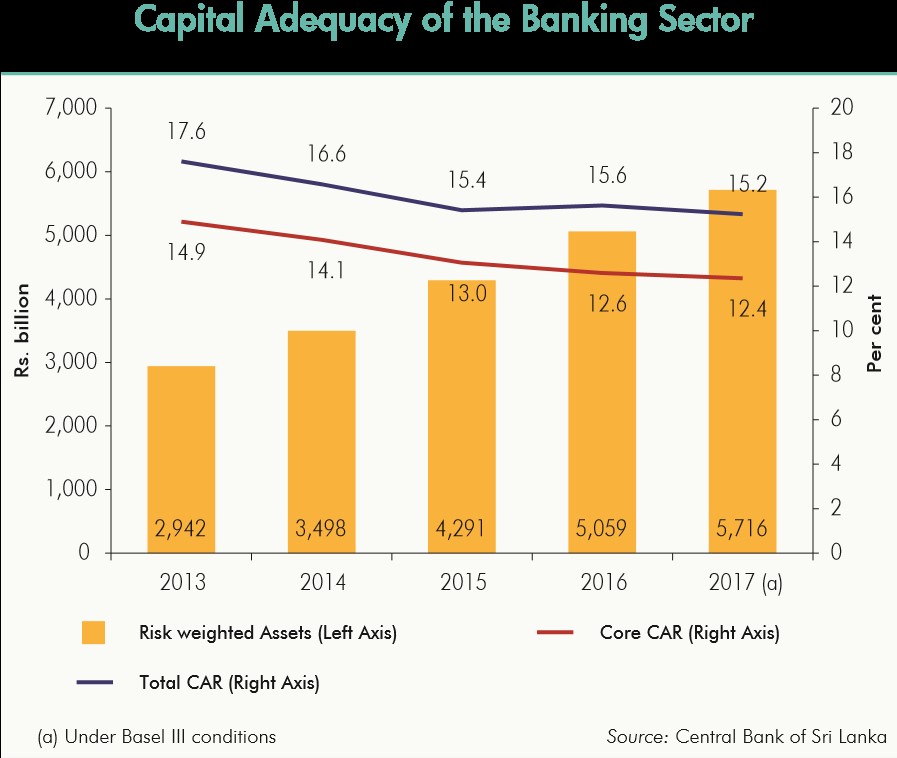
Measures helped the sector to maintain risks (credit, market, liquidity, operational and others) at manageable levels. Further, as a result of such prudential measures, undue concentration of loans was addressed, while operational performance and the resilience of the sector were further improved. Asset growth, which picked up during the first half of the year, gradually moderated during the second half of the year, following the adoption of targeted policy actions. Improvements in asset quality were seen in the decline in NPL ratios. Banking sector profits in 2017 improved compared to the previous year as reflected in the improvement in both the Return on Assets (ROA) and the Return on Equity (ROE) ratios. Overall, the banking sector operated with sufficient capital and liquidity buffers throughout the year.


·         Total liquid assets of the sector increased by Rs. 474 billion (19.2 per cent) to Rs. 2,939 billion by end 2017. Government securities accounted

        Composition of Statutory Liquid Assets of the Banking Sector


Item
2016 (a)
2017 (b)
Change (Rs. bn)
Share
Rs. bn
(%)
Share
Rs. bn
(%)
2016
(a)
2017
( b )
Treasury Bills
506.6
20.5
742.4
25.3
-176.5
235.9
Treasury Bonds
843.0
34.2
960.3
32.7
162.6
117.3
Sri Lanka Development Bonds
451.7
18.3
515.6
17.5
-11.4
63.8
Cash
122.0
4.9
165.5
5.6
5.9
43.5
Money at Call
114.8
4.7
109.8
3.7
-27.0
-5.0
Balance with Banks Abroad
322.2
13.1
307.7
10.5
93.1
-14.5
Other
105.6
4.3
138.1
4.7
-7.7
32.5
Total Liquid Assets
2,465.9
100.0
2,939.4 100.0
39.0
473.6
(a) Revised
(b) Provisional
            Source:  Central Bank of Sri Lanka


·         Liquidity Ratios


·         Annual Profit of the sector

Profit of the Banking Sector

Item
2016 (a)
2017 ( b )
Amount
(Rs. bn)
As a % of Avg.
Assets
Amount
(Rs. bn)
As a % of Avg.
Assets
Net Interest Income
304.3
3.6
341.6
3.5
Interest Income
757.5
8.9
971.9
9.9
Interest Expenses
453.2
5.3
630.2
6.5
Non-Interest Income
102.9
1.2
122.3
1.3
   Foreign Exchange Income
25.9
0.3
23.5
0.2


·         Capital Adequacy